MK’s council wins bring a different kind of political pressure


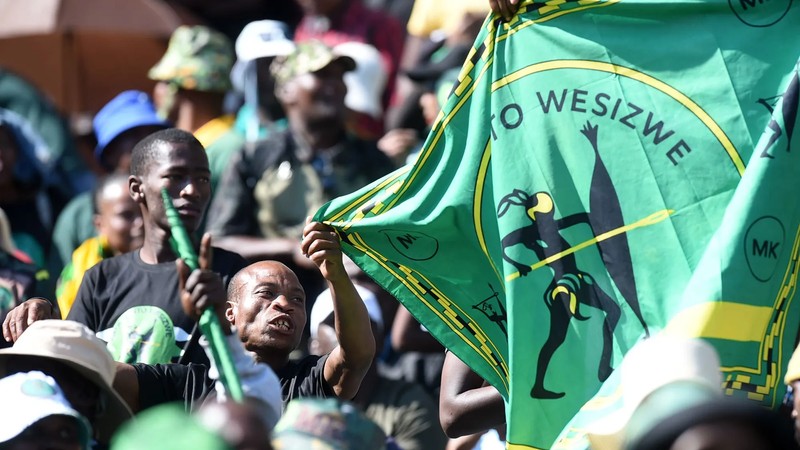
DURBAN — The MK Party’s first municipal election has delivered more than a foothold in local politics: outright majorities in several KwaZulu-Natal councils now give it an opportunity to demonstrate how it governs. That changes the basis on which voters can judge Jacob Zuma’s party, from its ability to challenge established opponents to its handling of municipal finances, infrastructure and everyday services.

At the 08:43 update on 7 November, dashboard of IEC results recorded approximately 1.39 million proportional representation votes for MK, representing 9.7% nationally, with 98.4% of voting districts reporting. That placed it third on the PR ballot, behind the ANC and DA and ahead of the EFF. These are provisional municipal PR figures, not a national parliamentary election result.
Because MK did not contest the 2021 municipal elections, there is no direct previous local election result against which to measure its growth. Its performance should instead be assessed through where it has established representation, where it can govern independently and where it still requires partners.
Council victories bring direct responsibility
The available seat figures show MK with 10 of Richmond’s 17 seats, six of Impendle’s 11 and 14 of the 27 seats in Johannes Phumani Phungula. Those majorities provide a stronger foundation for governing than a lead that depends on several coalition partners. They also make responsibility harder to diffuse when decisions go wrong.
In these councils, the party will have to move from promises to decisions about budgets, appointments and spending priorities. Residents will be able to assess whether its representatives respond to complaints, maintain infrastructure and oversee public money effectively.
Inherited problems will matter. A new council cannot immediately reverse years of infrastructure deterioration or financial weakness. But an inherited problem is also the starting point against which a new administration’s decisions should be measured. Publishing credible priorities, explaining financial constraints and reporting progress would give residents a basis for distinguishing unavoidable delays from poor performance.
For MK, these municipalities could become evidence that its appeal can sustain effective government. They could also expose weaknesses that an opposition campaign does not test. The outcome will depend heavily on the quality of its councillors and the professional administration they oversee.
Provincial strength does not guarantee control everywhere
KwaZulu-Natal remains central to MK’s electoral position, but the distribution of support complicates the picture. An IOL report on 7 November showed the IFP leading in 18 municipalities against MK’s 17, despite MK holding the stronger overall provincial vote. The same snapshot recorded five outright council majorities for the IFP and three for MK.
That illustrates why a provincial total cannot be treated as a map of governing power. Strong support concentrated in particular municipalities can produce a large aggregate vote without delivering the greatest number of councils. Each council has its own seat balance and negotiating possibilities.
MK has acknowledged that other parties can reach agreements that exclude it from government. That is a significant constraint where it finishes first without securing a majority: a plurality provides negotiating weight, but councillors ultimately determine who leads the administration.
The party therefore needs more than electoral strength to expand its governing reach. It must persuade potential partners that an agreement will be workable and that commitments will survive disagreements over appointments, expenditure and policy.
Disputes need evidence; governing needs organisation
MK has also lodged an objection concerning alleged irregularities in eThekwini’s voting, counting and electronic capture of results. Those claims require assessment through the electoral process; the objection itself does not establish that the result is incorrect.
Challenging a disputed result and preparing to govern are separate responsibilities. The party can pursue substantiated objections while developing budgets, selecting capable representatives and negotiating arrangements that protect municipal operations from political instability.
Its longer-term opportunity is to build an identity supported by a municipal record. Zuma’s political appeal has helped establish a substantial electoral presence, but reliable services require organisation that operates beyond a leader’s appearances and speeches. Residents need accessible councillors, functioning committees and decisions that can withstand scrutiny.
This election gives MK an opportunity to show whether it can make that transition. Its council majorities are meaningful victories, but the more durable achievement would be to turn them into administrations voters choose to retain because of their performance.
Readers can follow the latest available election results through TownPress’s live dashboard, available across the website, or visit our Election Results and Results Breakdown pages. Results remain provisional until officially declared by the IEC.
Anyone with additional information can contact the press desk at press@townpress.co.za or drop a tip.