The municipal vote gives SA’s top 10 parties different paths to 2029



PRETORIA — South Africa’s emerging municipal election results point towards a more fragmented contest in 2029, with the ANC still the largest party but rivals sharing the space around it. The next test is whether these parties can turn council representation and coalition agreements into governing records that persuade voters to support them nationally.

For a consistent comparison, the chart uses municipal proportional representation ballots only, rather than adding ward and district ballots together. It reflects IEC-derived results at 10:35 on 7 November 2026, when 98.6% of voting districts had reported nationally. These are provisional figures, not final national election results.
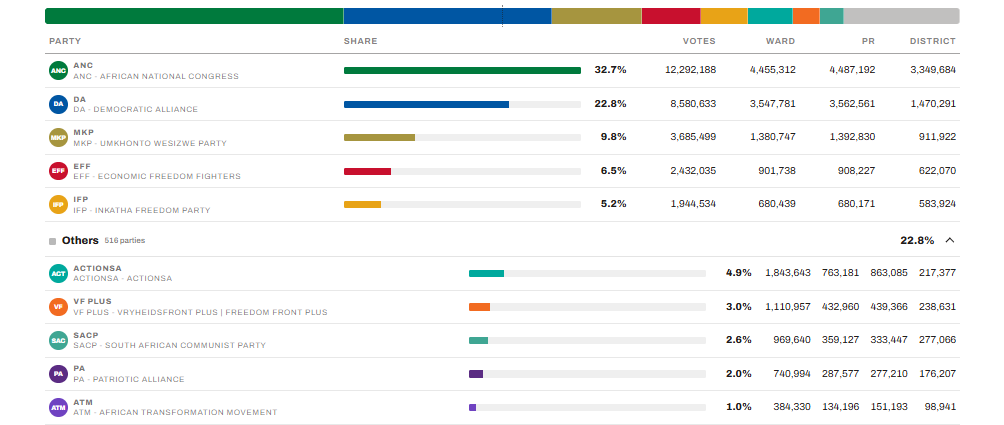
Source: Townpress Election, using IEC data. Percentages rounded. Ward and district ballots excluded. These are not projections for 2029.
That caution also has commercial relevance. In its analysis, Beyond the Ballot: the Business Stakes in South Africa’s 2026 Municipal Election, Millionsworth Public Relations argues that a leader’s reputation must be assessed alongside the council support and administrative resources available to deliver. Its section on leadership and governing capacity identifies coalition agreements, appointments and budget decisions as stronger evidence of direction after an election. For parties preparing for 2029, those decisions will also help determine whether electoral gains become credible governing records.
ANC: Its position remains substantial, but it must increasingly negotiate for power. The danger ahead of 2029 is that further municipal failures could reinforce doubts about its ability to renew itself. Its recovery would require visible improvements, credible appointments and consequences for misconduct. Remaining the largest party gives it influence; it does not ensure that support lost locally will return nationally.
DA: The party has a strong platform from which to challenge the ANC, but its next opportunity depends partly on governing beyond places where it has comfortable majorities. Successful coalitions could strengthen its argument that it can administer complex, divided cities. Failed agreements or poor delivery would weaken that case. Its 2029 prospects therefore depend on converting electoral competitiveness into a record that appeals beyond established supporters.
MK Party: Third place gives MK a meaningful position in the political contest reflected through these municipal ballots. Its opportunity is to build durable local organisations and demonstrate that its representatives can exercise power responsibly. Its risk is that public visibility and opposition appeal prove stronger than administrative capacity. By 2029, voters will have more evidence against which to assess its promises wherever it participates in government.
EFF: The party remains significant, but competition for dissatisfied voters is intense. ActionSA’s proximity in this PR tally illustrates how contested that space has become, although it does not prove direct movement between the two parties. The EFF’s route to a stronger 2029 result would involve rebuilding local organisation and demonstrating what its representation achieves. Parliamentary prominence alone cannot guarantee municipal loyalty or national growth.
ActionSA: Its opportunity is to turn increased support into a convincing governing proposition. The party is pushing to retain Nasiphi Moya as Tshwane mayor and says coalition partners must commit to stability and service delivery. A defensible municipal record could strengthen its national appeal by 2029; unstable partnerships could leave it sharing responsibility for the failures it campaigns against. Its challenge is to grow an organisation as well as negotiate positions.
IFP: Its prospects depend on retaining organisational strength while demonstrating relevance to voters beyond its established base. Effective municipal government could help it compete for people seeking dependable administration. The risk is that stronger rivals limit its expansion. Its influence in 2029 could remain important through coalition negotiations even without a dramatic national increase.
Freedom Front Plus: Its position offers opportunities for influence where council arithmetic makes its support valuable. The challenge is to show that this influence produces tangible outcomes for constituents while contributing to workable administrations. Before 2029, it would need to balance maintaining its political identity with the compromises required by coalition government. Consistent representation could consolidate support, but wider growth would require reaching additional constituencies.
SACP: Contesting independently has given the party a measurable electoral identity outside the ANC’s ballot. General secretary Solly Mapaila has proposed discussions among left-wing formations about a common agenda. Its 2029 outlook depends partly on whether it sustains independent electoral organisation and how its relationship with the ANC develops. A municipal foothold provides an opening, but does not establish a settled national election strategy.
Patriotic Alliance: The party’s test is whether local gains can survive the compromises of governing. Gayton McKenzie has said it is willing to work with the DA despite his opposition to it, illustrating the distance between campaign rivalry and coalition necessity. Its 2029 opportunity lies in demonstrating results; its vulnerability is that supporters may reject agreements they see as inconsistent with its promises.
ATM: Reaching this top 10 gives the party visibility, but its limited share leaves little room for complacency. Its strongest route towards 2029 would be to establish recognisable local representatives and a clear record of constituency work. Coalition participation could increase its influence, but would need to produce benefits voters can identify. Visibility without stronger organisation would leave its position vulnerable to competitors.
Across these parties, the most consequential development is the growing importance of governing together. A Saturday results snapshot reported by Jacaranda FM showed 122 of 190 completed councils without a single-party majority. That creates opportunities for parties beyond the largest two, while exposing more of them to responsibility for municipal performance.
Millionsworth Public Relations’ analysis adds a practical measure for assessing those administrations: whether commitments have financial support, responsibilities are clear and decisions can survive disagreement. Those conditions affect businesses’ operating costs, investment timelines and confidence in municipal relationships. They also give residents a firmer basis for judging parties than the allocation of mayoral positions alone.
The period before 2029 will test both parties leading councils and those enabling them to govern. Voters will be able to compare campaign promises with budgets, services and the durability of coalition agreements. Those records could change the national contest substantially; simply carrying today’s municipal percentages forward would miss that political work.
Readers can follow TownPress’s live dashboard across the website, or visit our Election Results and Results Breakdown pages. Results remain provisional until officially declared by the IEC.
Anyone with additional information can contact the press desk at press@townpress.co.za or drop a tip.