


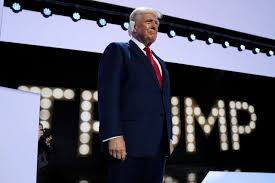
It appeared early in his speech on Thursday night that Trump had accepted his party’s presidential nomination at the Republican National Convention in Milwaukee. This was part of a well-planned attempt to reposition Trump as a more modest and unified figure who would be easier to win over swing voters on November 5.
Trump had earlier in the week admitted to the Washington Examiner that, following his near-death experience, he had ripped up the original address he was going to deliver in favor of one in which he preached national unity.
And that’s exactly what Trump did for the first five minutes of his address. He declared that he wished to unite the divided nation and serve as president for all Americans, even Democrats. He talked movingly about a fan who was killed by the gunman and described in great detail the attempt on his life last Saturday.
“In an age when our politics too often divide us, now is the time to remember that we are all fellow citizens,” Trump stated.
The duration of that new Trump was hardly thirty minutes.
Then the Trump that most Americans knew and loved—the blustery insulter who takes great pleasure in denigrating his rivals—resurfaced, stomping all over the unifying message that the Republican National Committee had laboriously orchestrated this week.
Trump called Democratic President Joe Biden the worst president in American history and former Democratic House Speaker Nancy Pelosi “crazy Nancy Pelosi” in a meandering 92-minute speech that broke the record for the longest convention speech in history. He also accused Democrats of starting judicial witch hunts against him and establishing a “planet of war.”
“The Democrat Party should immediately stop weaponizing the justice system and labeling their political opponent as an enemy of democracy, especially since that is not true,” Trump stated.
“In fact, I am the one saving democracy for the people of our country,” he stated.

He claimed that illegal immigration to the United States was “the greatest invasion in history” and that it was the cause of hundreds of thousands of American fatalities annually, using well-worn hyperbolic and divisive language. Neither of these claims is backed up by any evidence, though.
In keeping with his stump speech theme of portraying himself as the nation’s savior, he offered a bleak picture of a collapsing America, a society in decline, with its cities rife with crime and experiencing economic depression.
Following the event, Republican strategist and Trump detractor Mary Anna Mancuso stated, “We had been told this was going to be a different Trump, a softer side.” “Trump did not seek to unite the country in his speech. There was no difference; it was the same Trump that we had seen.”
Undoubtedly, Trump steered clear of some of the most caustic remarks frequently made at his rallies. He only referenced Biden by name twice, though he generally enjoys making fun of him as an embittered president.
Another Republican strategist, Frank Luntz, claimed that many people would have only watched the first thirty minutes of the speech because it was so lengthy and began so late. Luntz called the address “perfect.
“He believed that some of the most caustic aspects of Trump’s typical criticisms had also been softened. “It was traditional, typical Trump without as many of the usual hard edges,” observed Luntz.
On Saturday, Trump will make a comeback to the campaign trail when he speaks at a rally in Michigan, accompanied by U.S. Senator J.D. Vance, his freshly selected vice presidential candidate. Those who are dubious about the party’s transformation of him this week will be interested in seeing which Trump makes an appearance and how long the unification movement lasts.
Dedicated followers usually swarm to his rallies to witness Trump 1.0—the man who combines harsh language, conspiracy theories, and promises of retaliation against anyone he believes have mistreated him.
















Facebook Comments