


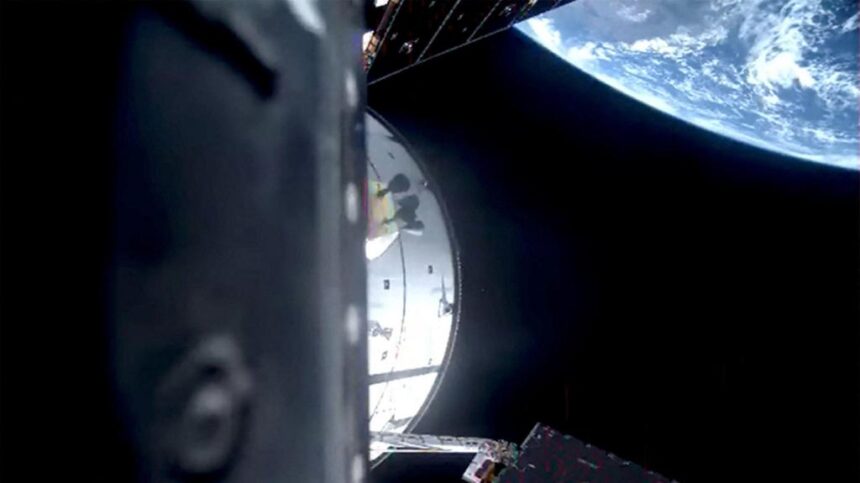
CAPE TOWN — Humanity has reached a new frontier in deep space exploration as the NASA Artemis II crew begins their journey back to Earth following a historic orbit around the lunar far side. This mission marks the first time humans have ventured to the Moon’s vicinity since the conclusion of the Apollo era, representing a significant leap forward in international space travel.
During the mission, the crew of four, consisting of three Americans and one Canadian, traveled further from Earth than any human mission in history. This milestone officially surpassed the previous distance record set by the Apollo 13 mission in 1970. The flight path took the astronauts behind the Moon, where they experienced a scheduled 40 minute communications blackout as they reached their closest approach to the lunar surface.
Mission Specialist Jeremy Hansen described the experience as transformative. He noted that observing the Moon and Earth in a three dimensional perspective felt as though the crew had been transported to another realm. Hansen characterized the seven hour flyby as an extraordinary human experience that left a lasting impression on the entire team.
The success of Artemis II is viewed as a critical technical validation for NASA’s broader lunar objectives. The data and experience gathered during this journey are intended to pave the way for an ambitious follow-up mission. NASA aims to land astronauts near the lunar south pole within the next two years, a region of intense scientific interest due to the potential presence of water ice.
The journey is not yet over for the crew, as they are currently homeward bound for a high stakes reentry into Earth’s atmosphere. The mission is scheduled to conclude later this week with a splashdown in the Pacific Ocean. This final phase will test the Orion spacecraft’s heat shields and recovery systems under real world conditions.
As the global scientific community watches the return of the Artemis II, the implications for future deep space travel become clearer. Beyond technical records, the mission serves as a psychological and operational bridge to long term lunar habitation. It marks the transition from short term exploration to a sustained human presence in deep space, signaling a new era of international cooperation in the stars.
Anyone with additional information relating to this story can contact us through email press@townpress.co.za.
















Facebook Comments