


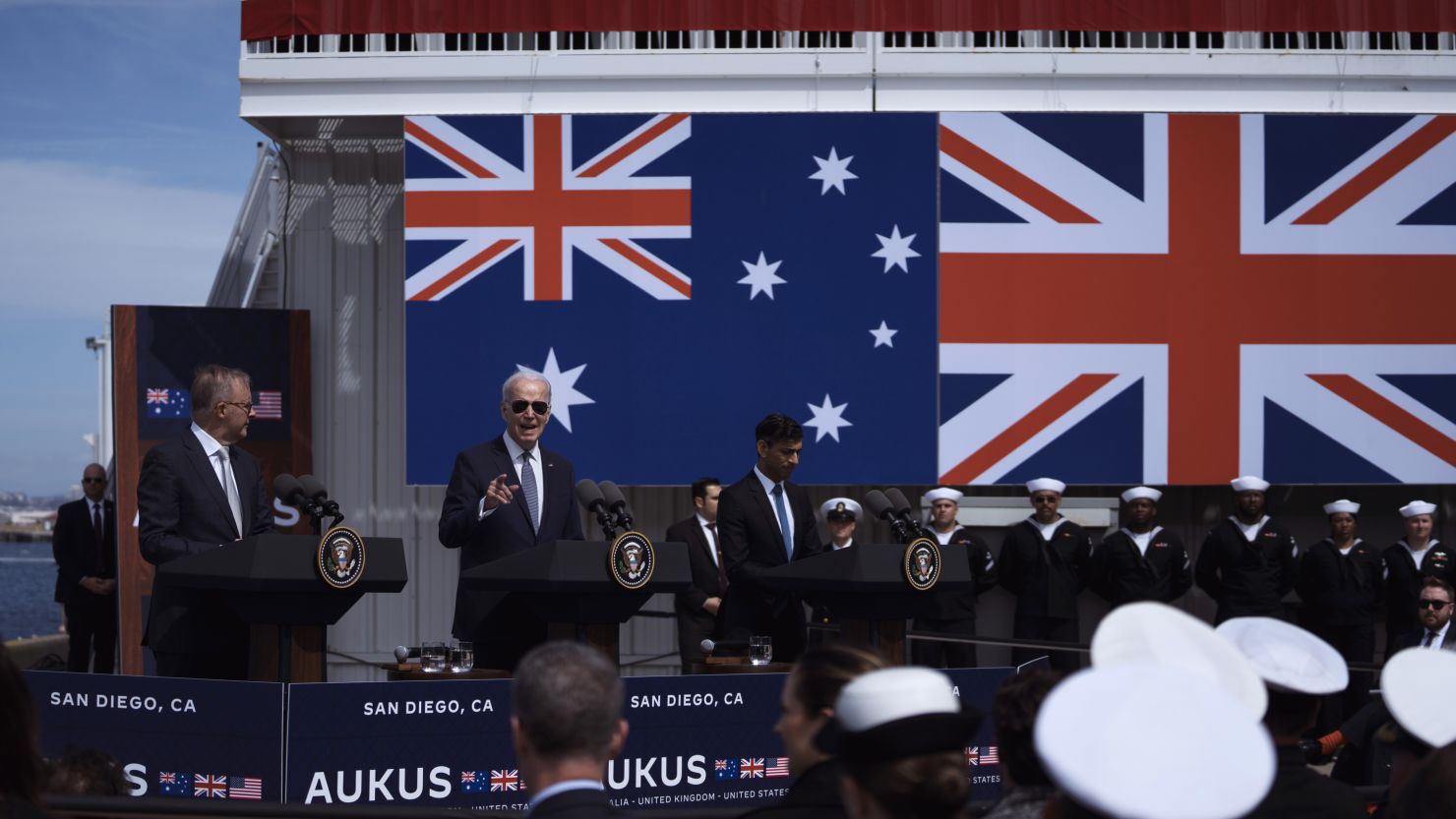
AUKUS was established in 2021 to allay concerns about China’s increasing influence. Its purpose is to enable Australia to purchase attack submarines with nuclear propulsion as well as other cutting-edge armaments like hypersonic missiles.
Cooperation has been hampered, though, by the transfer of highly guarded technology, which is subject to stringent US International Trafficking in Arms Regulations (ITAR).
President Joe Biden was mandated by the 2024 National Defense Authorization Act (NDAA) to assess if export control laws in Australia and the United Kingdom are “comparable to the United States” and, therefore, eligible for ITAR exemptions.
“Today, the Department of State submitted to the Congress a determination that Australia and UK export control systems are comparable to those of the United States and have implemented a reciprocal export exemption for U.S. entities,” the State Department stated in a statement.
It said that, as of September 1, export license exemptions for Australia and Britain would be implemented and that an interim final regulation amending ITAR would be published on Friday.
However, analysts predict that the final rule will include a list of sensitive technologies that are not eligible for ITAR exemptions. This means that considerable bureaucratic obstacles will still need to be cleared in order to implement the AUKUS projects.
Despite this, Australian Defence Minister Richard Marles referred to the revisions earlier on Thursday as a “generational change,” and a statement from the British government dubbed it a “historic breakthrough.
“”These critical reforms will revolutionize defense trade, innovation and cooperation, enabling collaboration at the speed and scale required to meet our challenging strategic circumstances,” Marles stated in a press release.
According to a State Department official, the license exemptions would speed up and increase the predictability of commercial defense trade for the United States, accounting for around 80% of its present value.

Approximately 3,800 defense export control licenses for Australia are issued by the United States annually; the clearance process might take up to eighteen months, but approvals in Britain typically take a hundred days.
According to Australian and American officials, the U.S. State Department will have 45 days to decide whether to approve the transfer of technologies between governments and businesses that are on the excluded list, and 30 days for transfers between nations.
A 90-day public comment period for the interim final rule, according to the State Department, would “allow for further refinement in subsequent rule-making.”
The goal was to “maximize innovation and mutually strengthen our three defense industrial bases by facilitating billions of dollars in secure license-free defense trade.
“Australia praised a draft regulation that was made public at the end of April as a game-changer, but some defense export control experts complained at the time that the exclusion list was so long that the policy changes were essentially worthless. Certain technology related to hypersonic travel and submarines were excluded.
According to the State Department official, “certain submersible technology, certain undersea acoustics technology” that is pertinent to AUKUS is still included in the amended list of exclusions.
This did not preclude them from being exported, either. The official explained, “All it means is that we need to see a license for that before it goes,” and that the applications would need to be handled in a timeframe of 30 to 45 days.
“We are going to make sure … that the trade can occur, that it can occur at the speed of relevance, securely,” added the official.
Following the draft’s release in April, industry associations and military companies requested that the list of exclusions be reduced during a month-long feedback session.
Although he acknowledged that the action was long overdue, Republican Michael McCaul, the chair of the U.S. House Foreign Affairs Committee, stated that “totally implementing AUKUS still requires a number of items that are not covered by this exemption.
“”Until the Excluded Technologies List is limited to only a handful of items — as Congress intended — big government regulation will continue to hamper this crucial alliance’s ability to truly deter a conflict in the Indo-Pacific,” he stated in a statement.
The final ITAR waiver’s specifics, according to Jeff Bialos, a former senior Pentagon official who is currently a partner at Eversheds Sutherland, will be crucial because if they are overly complicated administratively, they will be ignored and the goal of more technological collaboration would be compromised.














Facebook Comments