Friday, 3 Apr 2026

Current affairs publication that encourages citizens’ journalism

Explore Now
Townpress Newspaper
  • News
  • Africa
  • World
  • Opinions
  • Sports
  • Lifestyle
  • People
  • Motoring
  • Podcast
My News
  • ANC
  • Cyril Ramaphosa
  • eskom
  • facebook
  • twitter
  • SAPS
  • President Cyril Ramaphosa
  • Gauteng
  • DA
  • Nigeria
Townpress NewspaperTownpress Newspaper
Font ResizerAa
  • News
  • Africa
  • World
  • Opinions
  • Sports
  • Lifestyle
  • People
  • Motoring
  • Podcast
Search
  • News
  • Africa
  • World
  • Opinions
  • Sports
  • Lifestyle
  • People
  • Motoring
  • Podcast
Have an existing account? Sign In
Follow US
© 2014 - 2026 Townpress Newspaper, South Africa - Townpress logo & associated media rights are the intellectual property of Townpress Newspaper. All Rights Reserved.
Opinions

South Africa won’t become less violent until it’s more equal

Town Press
Last updated: September 13, 2018 9:24 am
By
Town Press
September 13, 2018
Share
7 Min Read
SHARE

The release of crime statistics in South Africa always triggers great angst among ordinary citizens and obfuscation on the part of the South African authorities. This year was no exception.

Contents
  • The question of police numbers
  • Targeted approach
  • Inequality
  • Where to from here

In their latest release of crime statistics, the South African Police Service seems to have tried to downplay crime rate increases (and exaggerate crime rate decreases), by using the wrong population estimates.

The police incorrectly used the June 2018 population estimates in their analysis of the 2017/18 crime rates. This is not the first time they have made this kind of bungle.

But their motivation is clear. Applying the correct population estimates suggests that the country saw the biggest per capita annual murder rate increase since 1994. Last year’s figures suggested that the murder rate had stabilised. But these were unfounded, as the murder rate has now risen to 36 per 100,000. The last time it was this high was in 2009. The increase is cause for serious concern.

Even the new minister of police Bheki Cele expressed shock at the numbers, describing South Africa as being close to a “war zone”. He admitted that the country’s police force “dropped the ball”.
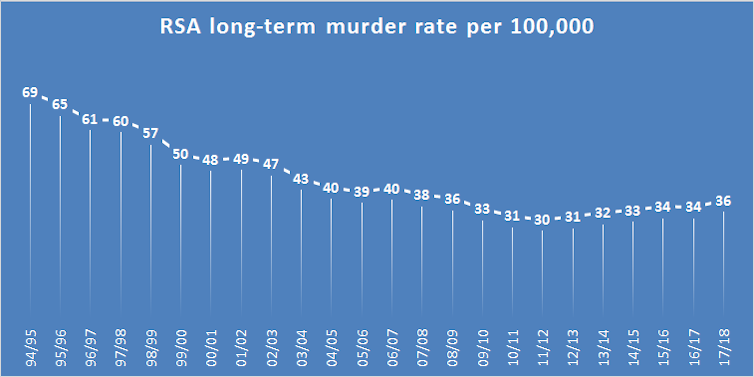
South Africa’s annual murder rate per 100,000.
Author supplied

A logical response might be that there is a need for more policing. According to Cele.

World Bank revises SA’s growth to 0.9%
Africa’s embrace helped him cope with mother’s death – Prince Harry
Zimbabwe to reconsider focus after crushing test defeat
Commentary: Yes, 2016 was bad. Next year could be worse

But this isn’t the answer. A sensible response to South Africa’s rising crime rates would be twofold: a problem-solving approach that would require a close analysis of what’s causing crime to rise in a given area. Then they’d need to devise a plan that takes into account all the contributory factors – and involves everyone affected in addressing it.

And, secondly, the country’s leaders must address inequality. South Africa is a highly unequal society. It has one of the highest gini-co-efficients (a measure of inequality) in the world. Research shows that inequality and crime go hand in hand.

The question of police numbers

Police leaders reported that their staff numbers have gone down by 10,000 since 2010. They argued that they had 62,000 fewer police than were needed.

- Advertisement -
Ad image

Police agencies all over the world often claim that to reduce crime, they need bigger budgets and more officers. But the evidence that these two things automatically lead to more effective crime prevention is far from clear.

Take the issue of police numbers. Short-term and extreme spikes in police numbers (such as in response to terrorist threats) do seem to reduce crime. But a review of a number of studies on the relationship between policing levels and crime rates suggested that the impact of more police is generally small. The paper also noted that part of the problem was that there have been few rigorous experiments on, for example, extra police resources being allocated randomly.

Bigger budgets also have mixed outcomes. This is because, very often, a significant proportion of spending on police is ineffectual. Police resources often aren’t targeted, even though there’s evidence that doing so produces good results.

This isn’t hard to do: crime is highly concentrated in hot spots that are often surprisingly small and quite stable over time. With the right focus, resources could be directed to these areas. But mostly they aren’t.

Targeted approach

What works best is a problem-solving approach. This involves focusing narrowly on understanding specific crime problems in specific places and using not only police but drawing on the knowledge and resources of all parties, including other government departments and local communities.

For example, particular factors might be contributing to a spike in robberies in a particular area. These could include a large cohort of bored young people in the community, paths that are fertile ground for attacks because they are dark and overgrown, or unlit parks near a derelict building.

More police patrols wouldn’t necessarily be the best solution. The underlying problems would need to be addressed. This might include creating a partnership between property owners, the agencies in charge of parks and lighting administration, schools and parents, and the communities that use the spaces.

One concern with a targeted approach is that crime is simply pushed elsewhere. But evidence suggests that the displacement effect is usually limited and that, in fact, nearby areas often enjoy a diffusion of benefits.

Inequality

There’s a more fundamental problem that needs to be solved on a national scale before South Africa’s crime levels can be reduced: inequality.

Research shows that inequality is arguably the single best predictor of whether a country will experience high or low levels of crime and violence. Inequality

  • makes property crime more attractive and profitable;
  • drives frustration, hostility and hopelessness; and,
  • undermines trust, community engagement and the functioning of social and institutional structures.

South Africa is one of the most unequal countries in the world.

Where to from here

Murder levels nationally have been at about this level or higher (above 30 per 100,000, which is considered very high by global standards) since at least the 1970s. High levels of violence are not a matter of police resources. They are a structural feature of this society.

This is not to say that the police are blameless. Among other things, they should be doing more to solve cases. But addressing the key drivers of crime and violence requires that South Africa builds a much larger social partnership. It has no hope of becoming a fundamentally less violent country until it becomes a more equal one.The Conversation

Anine Kriegler, Researcher and Doctoral Candidate in Criminology, University of Cape Town

This article is republished from The Conversation under a Creative Commons license. Read the original article.

Facebook Comments

.
  • Ramaphosa Confirms Makhubu as New SARS Commissioner
  • Reports Tie Pretoria North Search Operation to High-Profile Police Officer
  • E-Hailing Drivers and Small Enterprises Face Strain from Fuel Hikes
  • Ntshavheni Condemns ‘Igwe Ndigbo’ Coronation Amid KuGompo Unrest
TAGGED:Bheki CelepolicePolice Crime StatisticsSouth Africa
Share This Article
Email Copy Link Print
ByTown Press
Follow:
At Town Press, we believe that everyone with a story deserves to be heard. We’re building a dynamic, citizen-led journalism platform that makes news publishing accessible to all South Africans, from rural townships to urban centers, and from first-time voices to seasoned storytellers.
Previous Article Zuma avoids alleged plot to oust President Ramaphosa
Next Article Gigaba to appear before Gupta naturalisation inquiry
Leave a Comment

Leave a Reply Cancel reply

You must be logged in to post a comment.

Newsletter Subscription

Subscribe to our newsletter to get our newest articles instantly!

    FacebookLike
    XFollow
    YoutubeSubscribe
    MediumFollow
    RSS FeedFollow

    Top News

    Trending

    Ramaphosa Confirms Makhubu as New SARS Commissioner

    April 2, 2026
    Trending

    Reports Tie Pretoria North Search Operation to High-Profile Police Officer

    April 2, 2026
    Business

    E-Hailing Drivers and Small Enterprises Face Strain from Fuel Hikes

    April 2, 2026
    Community

    Ntshavheni Condemns ‘Igwe Ndigbo’ Coronation Amid KuGompo Unrest

    April 2, 2026
    Top News
    Police appeal for help to find missing couple
    Community
    Illicit Alcohol Under Scrutiny as Compliance Checks Intensify
    Community
    Henke Pistorius Breaks Silence on Son’s Character and New Venture
    Right now
    Three Bodies, One Grave: Ncumisa Selani’s Secret Murders Shocked Pretoria
    Community
    Private School Shock: King David Victory Park Closure Resurfaces in 2026
    Community
    Reality TV Star Mel Viljoen Claims She Acted Alone In US Retail Theft Case
    Trending

    You May also Like

    BreakingWorld

    Israel Insults South Africa on Official Social Media Account

    March 5, 2026
    CommunityWorld

    When Diplomacy Becomes Disrespect: Ramaphosa – Trump Meeting

    May 21, 2025
    Community

    ‘Cabinet members should be champions of NDP’

    September 5, 2018
    CommunitySport

    England need to hit the heights again to overcome Springboks

    November 1, 2019
    Show More
    • More News:
    • ANC
    • Cyril Ramaphosa
    • eskom
    • facebook
    • twitter
    • SAPS
    • President Cyril Ramaphosa
    • Gauteng
    • DA
    • Nigeria
    • Johannesburg
    • South Africa
    • zimbabwe
    • jacob zuma
    • EFF
    • Covid-19
    • KwaZulu-Natal
    • State capture
    • cape town
    • Hawks
    Townpress Newspaper

    Indigenous Newspaper created to embolden the township ideals of sharing information and connecting people to grassroots content locally and around the world. We believe communal stories are relevant, so we created the platform to tell the stories of real south africans, people you know.

    Facebook X-twitter Linkedin Youtube Medium Rss

    About Company

    • Contact Us
    • Advertise with US
    • Privacy Policy – T&C
    • Cookie Policy
    • Comments Policy
    • Submit a Tip
    Subscribe Now for Real-time Updates on the Latest Stories!
    © 2014 - 2026 Townpress Newspaper, South Africa - Townpress logo & associated media rights are the intellectual property of Townpress Newspaper. All Rights Reserved
    Manage Cookie Consent
    To provide the best experiences, we use technologies like cookies to store and/or access device information. Consenting to these technologies will allow us to process data such as browsing behavior or unique IDs on this site. Not consenting or withdrawing consent, may adversely affect certain features and functions.
    Functional Always active
    The technical storage or access is strictly necessary for the legitimate purpose of enabling the use of a specific service explicitly requested by the subscriber or user, or for the sole purpose of carrying out the transmission of a communication over an electronic communications network.
    Preferences
    The technical storage or access is necessary for the legitimate purpose of storing preferences that are not requested by the subscriber or user.
    Statistics
    The technical storage or access that is used exclusively for statistical purposes. The technical storage or access that is used exclusively for anonymous statistical purposes. Without a subpoena, voluntary compliance on the part of your Internet Service Provider, or additional records from a third party, information stored or retrieved for this purpose alone cannot usually be used to identify you.
    Marketing
    The technical storage or access is required to create user profiles to send advertising, or to track the user on a website or across several websites for similar marketing purposes.
    • Manage options
    • Manage services
    • Manage {vendor_count} vendors
    • Read more about these purposes
    View preferences
    • {title}
    • {title}
    • {title}
    Welcome to Townpress
    Username or Email Address
    Password

    Lost your password?