


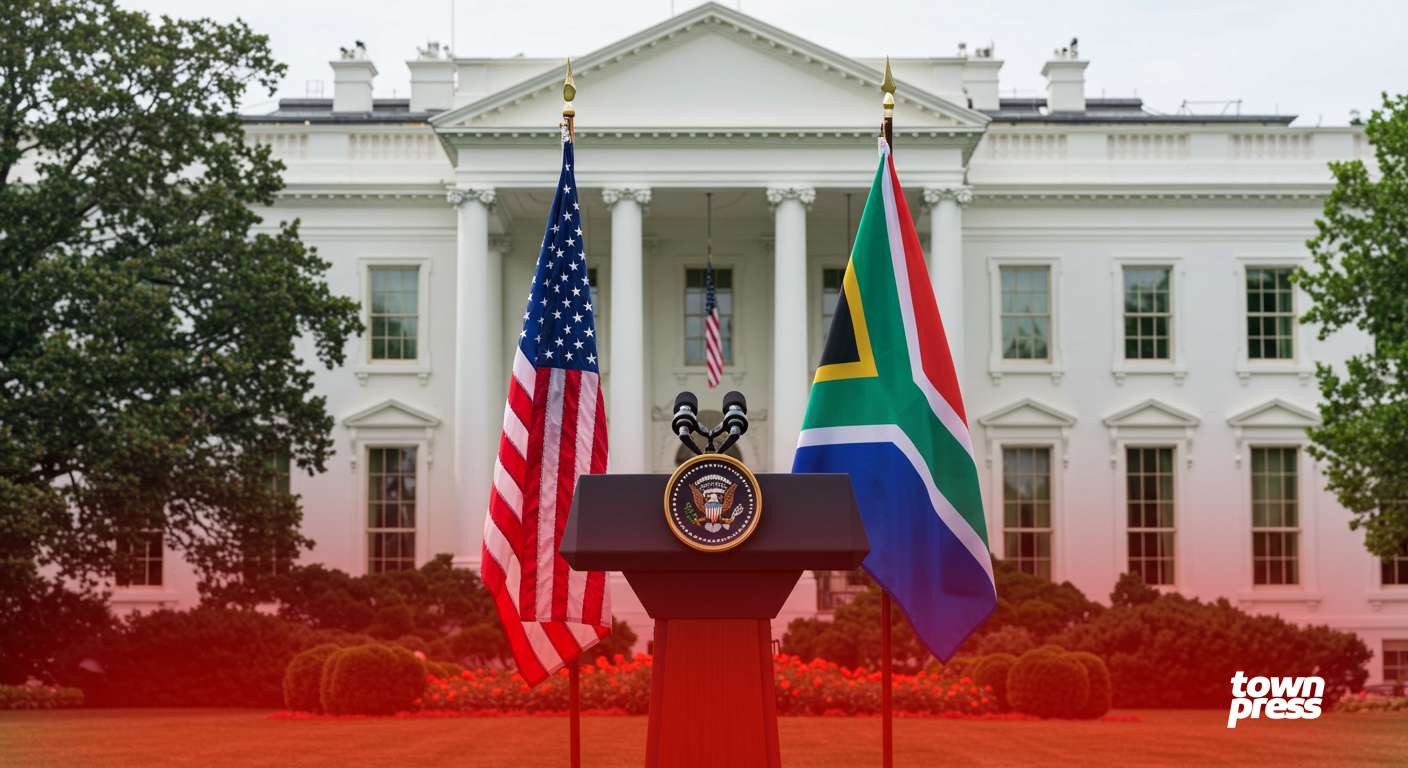
Washington DC – What should have been a diplomatic opportunity to reset relations between South Africa and the United States devolved into an unsettling display of imbalance, condescension, and political theatre. The May 2025 meeting between President Cyril Ramaphosa and U.S. President Donald Trump at the White House left many South Africans — and global observers — with a bitter impression: that Ramaphosa and his Black cabinet were not treated as equals, but as silent observers in a conversation about their own country.
The Tone of Disrespect
President Ramaphosa entered the meeting with a mandate: to address trade, investment, and cooperation in a post-COVID, economically complex world. But he was met instead with accusations rooted in far-right ideology — specifically, the baseless claim that South Africa is engaged in a campaign of “white genocide” against white farmers.
Trump not only reiterated these falsehoods, but reportedly played inflammatory footage before launching into his criticisms. In doing so, he completely shifted the tone from diplomacy to confrontation.
While South Africa’s democratically elected government was present and ready to speak, Trump instead turned the conversation over to a trio of white South African elites: Johann Rupert (billionaire and Richemont chairman), Ernie Els (golfer), and Retief Goosen (golfer). Elon Musk was also present, but notably, it was Rupert, Els, and Goosen who were given the floor — not Ramaphosa’s ministers.
This decision was more than symbolic. It was deeply political and racial. The optics were clear: Trump trusted the opinions of wealthy, white South Africans over the elected leadership of a Black-majority government.
A Meeting Hijacked by Power and Privilege
President Ramaphosa and his delegation of senior Black cabinet ministers, including Justice Minister Ronald Lamola, Minister in the Presidency Khumbudzo Ntshavheni arrived in Washington with an agenda of economic cooperation, diplomatic reset, and factual clarity on issues like land reform. But instead of a conversation among equals, the meeting became a platform for Donald Trump to push a racially charged agenda, centered on the discredited “white genocide” narrative.
Even more striking was who Trump allowed to speak. Despite Elon Musk’s presence, the voices given prominence in the room were Johann Rupert (billionaire businessman), Ernie Els (golfer), and Retief Goosen (golfer) — none of whom hold any formal government role. Their input was welcomed over that of the actual cabinet ministers. The scene suggested that wealth and whiteness still carry more diplomatic weight than democratic legitimacy.
The Silencing of Black Leadership
Justice Minister Ronald Lamola’s presence, for instance, was acknowledged but not engaged. The moment was less about diplomacy and more about dominance. The visible cringe when Rupert mentioned knowing Lamola, as if name-dropping a subordinate, was a stark reminder of how Black professionals — no matter how capable or credentialed — are still patronized in elite spaces.
South Africa’s Black leadership was symbolically caged — present, but voiceless. It was a chilling metaphor for the broader global dynamic where African governments must constantly justify their actions to former colonizers and economic overlords, often in their own voices, and still be ignored.

John Steenhuisen: Fence-Sitting or Quiet Strategy?
Democratic Alliance leader and Agriculture Minister John Steenhuisen positioned himself ambiguously. While he stopped short of endorsing Trump’s “white genocide” rhetoric, his framing of South Africa’s crisis as merely a “security concern” sidesteps the racial undertones of the debate and avoids direct confrontation with far-right disinformation. This strategic neutrality, framed as diplomacy, has been widely interpreted as fence-sitting — an attempt to remain palatable to conservative voters without explicitly rejecting global narratives that harm South Africa’s international image.
More revealing, however, was Steenhuisen’s comment about joining hands with President Ramaphosa to “keep Julius Malema out of government.” While masked as political pragmatism, this statement smacks of a quiet, elite pact to preserve a centrist status quo — not by democratic merit, but through tactical exclusion. It’s not diplomacy. It’s scheming.
The DA’s Fragile Cape Stronghold
Ironically, the DA’s failures in the Western Cape — often touted as a model of governance — were pointed out bluntly by Johann Rupert himself. Crumbling infrastructure, deepening inequality, and social unrest in areas like Cape Flats expose the party’s over-marketed record. Rupert’s critique may have come from a place of concern, but it served as an indirect rebuke of the DA’s hollow claims of competence.
This Was Not a Diplomatic Win — It Was a Warning
The White House meeting was not diplomacy — it was a staging ground for racialized narratives, class elitism, and geopolitical manipulation. President Ramaphosa handled the moment with composure, but the message was clear: African leadership is still too often mistrusted, undermined, and muted.
Domestically, the blurred lines between political parties, business empires, and international power brokers reveal the persistent backroom culture that threatens South Africa’s democratic trajectory. As long as leadership is judged by inherited capital and not democratic mandate, the country’s efforts at transformation will continue to face sabotage — both from within and without.
The Broader Implications
This wasn’t just a personal snub to Ramaphosa. It was an institutional insult to South Africa’s sovereignty and dignity. By elevating unelected figures over elected officials, Trump sent a clear message about whose voices matter on the international stage — and whose do not.
It also exposed a Western bias that still persists: that Black-led nations must constantly prove their legitimacy, while white capitalists are presumed credible by default.
South Africa did not come to Washington to beg. It came to engage. And yet, its leadership was treated with suspicion, not solidarity.
If global diplomacy is to mean anything in the 21st century, it must be built on mutual respect — not racial nostalgia, not class privilege, and certainly not the silencing of elected leaders.
This meeting may have been historic — but for all the wrong reasons.











Facebook Comments