


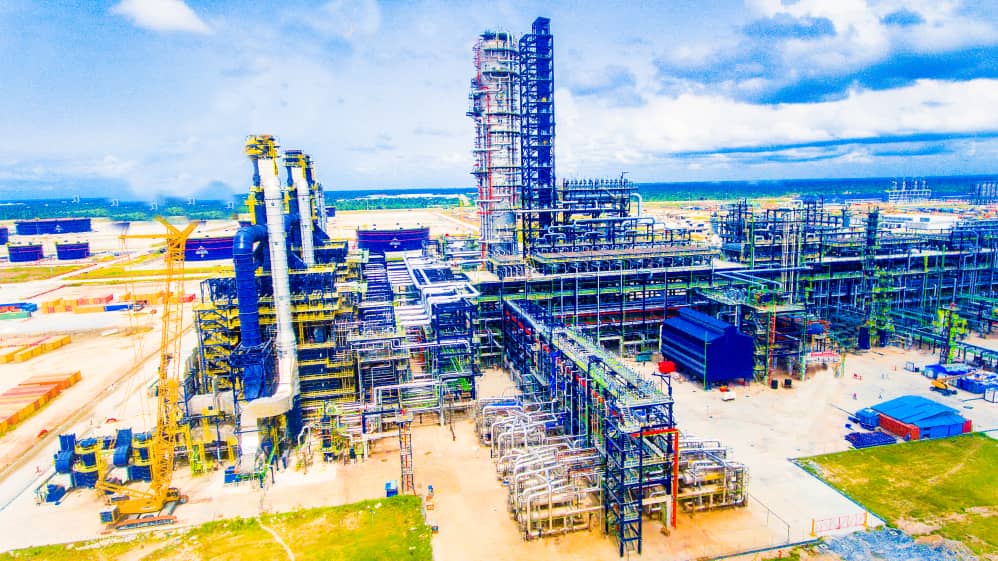
George Ene-Ita, a spokesman for the NMDPRA, stated that the organization had completed its task and would not take sides in the media over Farouk Ahmed’s allegations that Dangote’s fuel is higher in sulfur than imported diesel.
Ene-Ita reports that the authority has approximately fifteen engineers and scientists stationed at the Dangote refinery. A new report regarding the refinery’s sulfur content is scheduled to be released on Monday, which is today.
Ahmed reportedly claimed that there is a significant sulfur content in the fuel that comes from the Dangote refinery.
In response to Dangote’s accusations last week that the NMDPRA was granting permits to some dealers to bring filthy fuel into Nigeria, Ahmed contended that the fuel supplied by Dangote had a higher sulphur level.
He added that the refinery, which has been selling aviation fuel and diesel in Nigeria for months, was still in the pre-commissioning stage and had not yet received a license.
The assertion made by certain media outlets that attempts were made to shut down the Dangote refinery is untrue. Pre-commissioning is still ongoing at the Dangote refinery. We haven’t licensed them yet, thus it hasn’t been licensed yet. They are presently in the preparatory phase. I estimate that they are around 45% done,” Ahmed said.
The head of NMDPRA issued a warning, saying Nigeria could not rely solely on the Dangote refinery to supply its fuel.
He claimed that in order for the refinery to become Nigeria’s exclusive fuel supplier, it had asked the regulator to stop granting import licenses to other marketers.
Dangote is asking that we ban or cease the importation of all petroleum products, particularly AGO, and divert all marketers to the refinery; this is not good for the country’s energy security, so we cannot rely solely on one refinery to feed the country. And because of monopolies, that is bad for the market,” he emphasized.

He made the following statement regarding quality: “AGO currently has the lowest sulfur content in relation to the West African criterion of 50 ppm.
“Dangote refinery produces between 650 and 1,200 ppm, as do some modular refineries as Waltersmith and Aradel refineries. Thus, their product is far less superior to the imported quality in terms of quality, he claimed.
Reacting to a weekend tour of the refinery by members of the House of Representatives led by Speaker Hon. Tajudeen Abbas, Dangote said that fuel imported from other countries is not as high-quality as petroleum refined at the largest single-train refinery in the world.
The speaker and other participants had watched as automotive gas oil from two gas stations and the Dangote refinery were tested side by side.
The legislators obtained the fuel samples from two reputable filling stations close to Eleko junction on the Lekki-Epe Expressway in Lagos.
The collection of samples from the Dangote refinery’s Mild Hydro Cracking unit was overseen by the chairs of the House Committees on Downstream and Midstream, Ikeagwunon Ugochinyere and Okojie Odianosen, respectively, in order to test every sample.
According to reports, Dangote’s diesel exhibited a sulphur content of 87.6 parts per million (ppm) in the laboratory testing, whilst the other two samples had sulphur levels that exceeded 1,800 ppm and 2,000 ppm, respectively.
Dangote’s criticise in NMDPRA
Speaking, Dangote emphasized that the results refuted Ahmed’s assertions that imported diesel is superior to locally produced refined goods.
The wealthiest person in Africa publicly questioned the regulator, urging an unbiased evaluation to ascertain which refined goods from his refinery are of higher quality than those that are imported.
“In Nigeria, we make the best diesel.” It is depressing that the regulator is weakening the market rather than protecting it. Transparency is very important to us, thus we welcome the regulator to test our products at any moment. To enable Nigerians to make comparisons, it would be advantageous for the regulator to present its laboratory to the world. Since we have limited potential for growth if Nigeria doesn’t flourish, Nigeria is of utmost importance to us.
Dangote contended that the imported goods that Ahmed was pushing had not passed testing, and that the majority of importers were using forged certificates as the lab owners had been instructed on what to write
“If you are saying how can Dangote alone supply the market, are you saying the N4bn that the NNPC spent now on the activation of their refineries in Kaduna, Warri, and Port Harcourt is down the drain?” Dangote responded to the accusation of monopoly. Will the refineries cease operations? A date has been announced. We cannot be a monopoly if they exist because they are more powerful than we are and we are not the only ones. Thus, it is not possible for us to have a monopoly.
He continued, “I am surprised for somebody to come and mention that we and other modular refineries have a bad quality,” in reference to the sulfur concentration. I am unable to comment on the quality of the modular refineries, but ours is currently at 87 ppm; by Monday, it will drop to 50 ppm, and by the start of August, it will reach 10 ppm.
“Every test certificate that individuals are showing off these days is a phony. The laboratories are where? The lab is here.
It is extremely regrettable when a regulator tasked with protecting the company demarkets it. We manufacture the best diesel in Nigeria, and the regulator is welcome to visit us at any moment to carry out testing. I want our lab to be featured in the media, and I also want the regulator to identify the lab that he uses. He is expected to have a lab because he is a regulator. We have a problem if the regulator lacks a lab because he is not able to rely on anyone.
He is expected to examine usIn response to the assertion that Dangote’s diesel contains 87 parts per million of sulfur, an NMDPRA representative suggested that a lot may have changed in just five days.
“We’re not in conflict with anyone. A native, indigenous refinery is the same as a Dangote refinery. In the media, we don’t fight; we are regulators. That concludes our work for now.
It is important to note that we are working with engineering and time, which implies that any assertions made may be proved or refuted by testing. As you may remember, the ACE said as much on the fringes of an interview on Wednesday. A lot can change in the five days that have passed since then. Therefore, 500 or 650 ppm might be anything.
“What I’m trying to say is that, since it’s Sunday night, I’m not able to provide you with any concrete results until maybe tomorrow, when we can examine our technical report, which has to have been turned in by our engineers who work there. Typically, we receive weekly reports. These specific duties are completed from Monday through Sunday of each week; our engineers are still on site and operations are continuing. I therefore am unable to comment on the refinery’s assertions at this time, Ene-Ita said.
He retorted, “Of course we have laboratories all over the country,” in response to the suggestion that ACE would be using a report from other laboratories to characterize his gasoline as inferior. Is Dangote employed by NMDPRA? He is not employed with NMDPRA.
The NMDPRA representative became enraged at the accusation that the agency was undermining a corporation it was tasked with safeguarding, questioning whether Dangote desired the agency to skew the regulations to his advantage.
“Why should any firm be protected? We oversee operators; we are not there to protect anyone. We are merely regulators. Protect indicates that we are providing a shield. It implies that we ought to stray from the norm. We regulate every corporation, not just one.
And we don’t demarket, is that right? Demarketing your rivals is the only way to obtain the upper hand. There is no rivalry between us and an operator. The term “demarketing” is reserved for situations in which two rival brands are at odds. As regulators, we are not operators. How are we going to demarket? In the interest of my organization, please accept my objection to it. Nobody is being demarketed by us. He clarified, “We regulate all local refineries, including NNPC.
He responded, “That’s what we are doing,” when it was suggested that the business mogul meant the regulator should be increasing local refining capacity. Currently, more than fifteen engineers and scientists from the NMDPRA have been collaborating with them for how many months? That is how our reports are obtained. There are scientists and engineers that work for us. That’s how they come to us. I say this often because I don’t want to make this a personal issue. We are attempting to see that the capacity for local refining is increased to the point where we can produce all of our own gasoline locally.
Dangote brings in crude oil.
As it works to overcome issues with domestic crude supply, the Dangote refinery is in talks with Libya to acquire crude for the 650,000 barrels per day plant and would also seek Angolan oil, a senior executive named Devakumar Edwin said.
Despite being the largest oil producer in Africa, Nigeria is beset by issues such as theft, pipeline vandalism, and insufficient investment. Since Dangote started operations in January, it has been unable to obtain sufficient quantities of petroleum from Nigeria.
Dangote has had to buy petroleum from the US and Brazil, among other places.
“Talks regarding the import of crude are ongoing with Libya,” Edwin said late on Saturday. “We will also speak with Angola and a few other African nations.”
He stated that foreign traders and oil corporations were among the largest purchasers of Dangote’s gasoil, which was mostly being exported, but he would not provide specifics about the discussions.
The two largest traders, Trafigura and Vitol, along with BP and, to a lesser degree, TotalEnergies, are the main off-takers. However, they’re all claiming to be taking it offshore, according to Edwin.
Dangote is displacing European refiners in the gasoil market by increasing exports to West Africa, according to traders and shipping statistics.
According to Dangote, the refinery intends to stop importing refined fuel into Nigeria and will start selling Premium Motor Spirit in August.
Marketers were concerned.
Nigerians and merchants, however, have been vocal about their concerns with the ongoing disputes, particularly since the regulator said that Nigeria would continue to import refined petroleum products.
We recall that Edwin, the vice president of oil and gas at Dangote Industries Limited, accused the NMDPRA of arbitrarily awarding licenses to marketers to bring in filthy refined products, even as he accused the IOCs of plotting to obstruct the refinery.
Edwin claims that although the Federal Government of Nigeria granted 25 licenses for the construction of refineries, only the Dangote Group fulfilled its commitment.
The vice president reported that during the previous three months, the refinery had exported more than 3.5 billion liters of aviation and diesel fuel to Europe. It was stated that around 90% of the fuel produced was exported.
“Out of the 25 licenses granted by the Federal Government to construct refineries, only ours fulfilled our commitment. We essentially deserve all of the government’s assistance. It is noteworthy that almost 3.5 billion liters, or 90% of our total production, have been exported since the beginning of manufacturing. Edwin said, “We are pleading with the federal government and regulatory agencies to provide us with the essential assistance to generate jobs and prosperity for the country.
It was claimed that “licences are being issued, in large quantities, to traders who are buying the extremely high sulphur diesel from Russia and dumping it in the Nigerian market,” despite the fact that Dangote was producing and bringing diesel into the market in accordance with the rules of the Economic Community of West African States.
Edwin bemoaned, “The Dangote refinery has expanded into foreign markets as a result of the Nigerian Midstream and Downstream Petroleum Regulatory Authority’s decision to grant licenses indiscriminately for the importation of dirty diesel and aviation fuel.” Recently, the refinery exported aviation fuel and diesel to Europe and other regions of the world. The same industry players opposed us when we attempted to lower the cost of aviation fuel and diesel, but as I have stated, our goal is to expand our economy.
He mentioned that the refinery has been able to sell its products to Europe and other regions of the world because it satisfies international standards and follows strict guidelines and laws to protect the local environment.
“It is unfortunate that import permits are still issued in Nigeria when it is known that we are capable of producing about twice as much as is required domestically and even exporting the excess. According to Edwin, ECOWAS regulations have made it illegal to import highly contaminated diesel into the region as of January 2021.
On the other hand, several Nigerians on the internet have urged President Bola Tinubu to fire the CEO of the NMDPRA for asserting that fuels made at local refineries are inferior to those made abroad.
The House of Representatives declared that the claims would be looked into as well.










Facebook Comments