


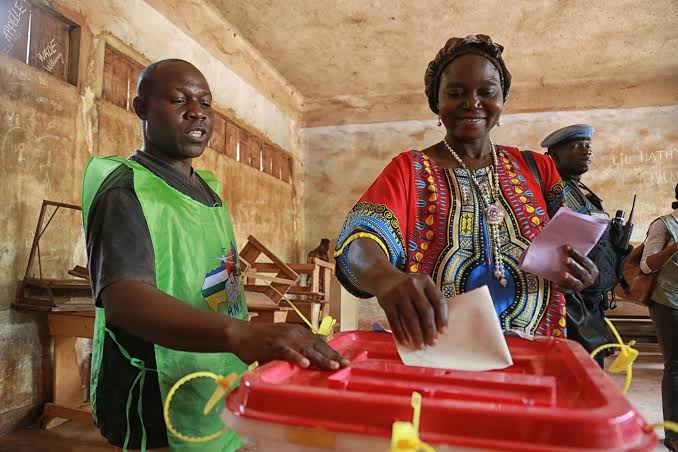
The Central African Republic (CAR) has once again delayed its long-overdue local elections, shifting the planned August 2025 date to December.
The move has intensified political tensions, deepened public mistrust in the electoral process, and triggered fresh calls for reform from opposition parties and international observers.
The postponement was confirmed by Prime Minister Félix Moloua during a Strategic Committee meeting held on 11 July 2025. As a result, the local elections will now be held concurrently with the presidential and parliamentary elections, also scheduled for December.
This overlap has sparked concern over the country’s preparedness to manage three critical votes simultaneously.
Local elections have not been held in the Central African Republic since 1988, and repeated delays since 2022 have only fuelled frustration and scepticism.
The National Elections Authority (ANE), which oversees the electoral process, cited both financial and technical obstacles, including challenges with biometric technology and inadequate funding.
The ANE missed a critical 29 May deadline to complete the electoral register and failed to compile a final list of voters by 4 June as mandated. Further complications arose from logistical delays, including inaccuracies in deploying staff and slow progress in finalising contracts.
A United Nations (UN) expert, Yao Agbetse, warned that these operational shortcomings threaten the integrity of the process and underscored the urgent need for institutional reform.
Crucially, funding allocated so far only covers the local elections, leaving a significant gap in resources for the upcoming presidential and legislative races. The financial shortfall raises concerns about the feasibility and fairness of holding all three elections at once.

Meanwhile, the political opposition has intensified pressure on the government. The Republican Bloc for the Defence of the Constitution (BRDC), a key opposition coalition, has demanded a complete overhaul of the electoral body and called for high-level talks with President Faustin-Archange Touadéra. They argue that without major structural changes, the ANE lacks the capacity to deliver credible elections.
In an effort to enhance transparency, the government introduced biometric voter registration in 2024. However, several registration centres remain closed due to ongoing insecurity, and many regions still lack a completed voter roll.
The United Nations and Security Council have echoed local concerns, urging the CAR to accelerate preparations and implement reforms before the December deadline.
Amid the political uncertainty, there has been a rare sign of progress on the security front. On 10 July 2025, rebel leaders Ali Darass and Sembe Bobo announced the official dissolution of their armed groups during a reconciliation ceremony presided over by President Touadéra.
The move is seen as a step towards peace and national unity, with the UN stressing that credible elections are key to sustaining stability and democratic governance.
Despite its vast mineral wealth, the Central African Republic remains one of the world’s poorest countries. International observers continue to advocate for increased support to ensure the country can carry out reliable, inclusive, and peaceful elections by the end of the year.











Facebook Comments