


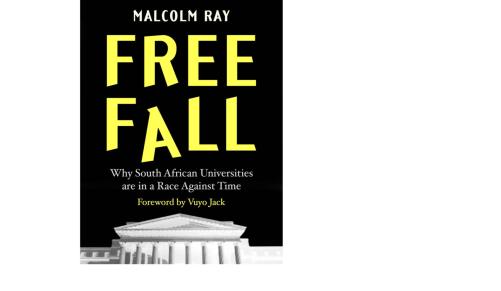
This is an extract from Malcolm Ray’s book, Free Fall: South African Universities in a Race against Time.
The thinking that reformists in government and corporate South Africa could do business, and that a growth as opposed to redistribution doctrine could reorient the country towards development and redress, ran high up the policy chain during Thabo Mbeki’s presidency.
But Mbeki’s accomplishments will for ever be sullied by rationalisation exercises that did more to close the space for youths to progress through the education value chain.
When I arrived at the school in Hammanskraal, north of Pretoria, in February 2000, summer was going full blast.
The shade in the prefabricated classrooms offered some relief from the blinding yellow light, but the heat hung oppressively.
In the first hours of my visit, one of the first things that struck me was the look on the faces.
I was aware of the abrupt intensity of the youths’ stare. It came from the constant fear of failure, of hardship, and of resigned disappointment and defeat, and even more from the sense of a transformation project going horribly wrong every minute of every day: a generation of black youths thrust together into something uncertain and new.
Physically, the school appeared to be stricken, or decaying from a grave affliction.
For a while, it was mordantly effective at a basic education level, but it now had the quality of a malevolent and inescapable free fall, turning everyone into casualties.
I remember driving south across the sun-blasted township to a private school in Johannesburg and being stupefied that all the high-altitude arguments about transformation and equity had actually led to this – this privatised oasis.

At an annual fee of R20 000 (by 2015, R70 000), enrolment was a haven of wealthy white exclusivity. There were a handful of black pupils I met.
By 2000, there was a discernible flight of qualified white teachers and pupils from newly integrated former Model C public schools to private schooling.
It was hard not to be impressed by the splendid vista of this private college, stretched between rows of trees and blazes of flowers.
In reality, the two schools still nestled in the bosom of apartheid. Twenty years ago, we gazed as many of the country’s black youths, politicised during the 1980s insurrection, stepped into a brand new era.
By 2000, education was a non-stop crisis, and a new generation of youths existed in a sort of temporal bubble; any attention to a past or future was vanquished. There was only the present.
On my next visit to Hammanskraal, in late 2006, I found the school still shrouded in the shadow of a past that lay heavily on the township’s youth.
The place combined all the cruelty and injustice of the old regime, with some of the austerity of the new; a product no doubt of apartheid state planning perverted by the prohibitive class dynamics that had settled into the social fabric of the country since 1994.
The youths were told that they were born-frees; they expected to experience freedom; they had been waiting for years to be free – but they didn’t feel free. One month before the end of his term in 1998, President Nelson Mandela had declared in a visionary speech that integrated education would become a democratic model for the youth.
The youth heard him, and as an unemployed matriculant in Hammanskraal told me, “We expected returns. That’s why we didn’t fight. And we are shocked, as if we’ve gone back to apartheid. We feel betrayed.”
“Betrayal” was in fact many acts: the economic crisis, limited resources, elitism, corruption – but also the ingrained sense of racial inequality.
With it came disappointment at what the government could achieve, and the disappointment in youths’ minds was only heightened by the performance of the education system. At the cost of dysfunctional school leavers, thwarted hopes and aspirations, and a deep sense of betrayal, the public education system that once appeared full of promise was failing the grade.
Some writers have termed the born-frees “our new lost generation”, adding: “They lack the power of knowledge to experience freedom.”
The phrase captured the truth about black youth in the years following 1994. It helped to explain one of the great myths after the end of apartheid: why the moment of good feeling was short – a worrying trait, given the vision the government had signed up for.
For someone who evoked a mystical air, Mbeki’s legacy was as complex as the man himself.
Before 1994, South African education was a ramshackle polyglot of inferior schools and universities for blacks. By and large, it was Mbeki who brought the level of efficiency, professionalism, and centralised control that became notoriously associated with his presidency.
Jay Naidoo, then minister in charge of the RDP, recalled a process of “dissembling policies and structures” set up to promote redistribution.
“When I look back, one of the things we took for granted is the notion that if you put more money into health you get more public health; if you put more money into public education more people get educated, etc.
“In effect, we underestimated the policy impact of Gear (growth, employment and redistribution), which was to reduce the state’s capacity to intervene.”
It had become apparent by then that Gear would not help reduce educational inequalities, precisely because it was not a strategy to distribute income and wealth equitably.
The restructuring of the public sector had led to many civil servants, many of them teachers, taking voluntary severance packages. Among those remaining in the profession, morale was low.
This was not surprising, since, with reduced expenditure, teachers’ workloads increased – larger classes, more periods, a lack of teaching materials – and salaries declined in real terms.
The world looked like a different place by the end of Mbeki’s presidency. If the apartheid era produced a lost generation of unemployable youths, by 2008 the ground shifting beneath South Africa’s sclerotic economy was producing a generation of lost opportunities for the so-called born-frees – school-leavers born after 1994 and ill-adapted to the academic rigours of higher education and the demands of a fiercely competitive modern economy.
The sheer scale of the problem far exceeded expert predictions in the mid-1990s of a groundswell of mainly black entrants into universities.
There were 27 million youths who bemoaned the new order.













Facebook Comments