



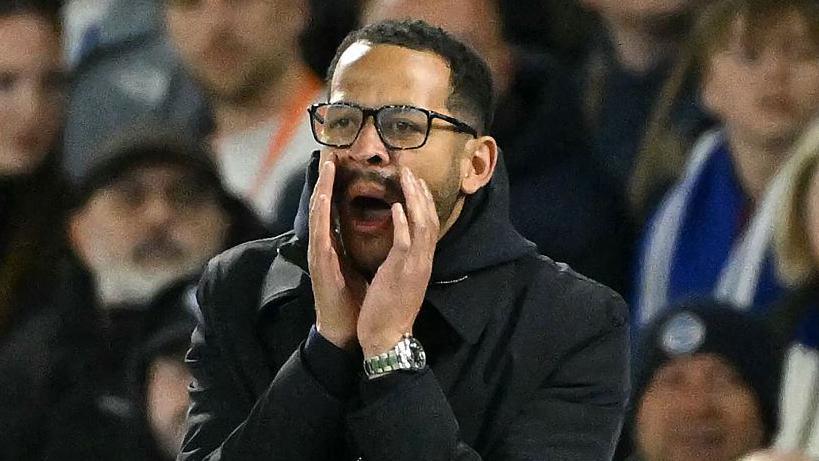
Chelsea have parted ways with head coach Liam Rosenior after just 106 days in charge, bringing a swift end to a tenure that struggled to deliver consistency or results at Stamford Bridge.
Rosenior had arrived from RC Strasbourg Alsace on a long-term deal backed by club owners Todd Boehly and Clearlake Capital, in what was seen as a forward-thinking appointment. However, the move has ultimately failed to produce the desired turnaround, with Chelsea opting to make a decisive change before the season’s conclusion.
Poor Form And Brighton Defeat Prove Decisive
The final blow came in a 3-0 defeat to Brighton & Hove Albion, a result that extended Chelsea’s alarming run to five consecutive league defeats without scoring. It marked the club’s worst goal drought in league competition since 1912.
That result left Chelsea seventh in the Premier League standings, seven points adrift of a Champions League qualification spot currently occupied by Liverpool FC.
Across all competitions, Rosenior managed 11 wins in 23 matches. While there were positive moments in cup competitions, league form proved damaging, with momentum slipping away at a critical stage of the campaign.
Statistical Decline Highlights Deeper Issues
Chelsea’s struggles under Rosenior were reflected in a series of concerning statistics that pointed to both attacking and defensive inefficiencies.
The team recorded just one win in their last nine league matches and accumulated only five points over that period, among the lowest returns in the division. A prolonged lack of clean sheets, now stretching to 12 league games, further exposed defensive vulnerabilities.
Attacking output also declined sharply, with Chelsea often failing to create meaningful chances. Their performance against Brighton, where they registered minimal attacking threat for long periods, underlined a broader issue in chance creation and tactical execution.
Set-piece defending has also been problematic, with Chelsea conceding frequently from corners, placing them among the weaker sides in that aspect of the game this season.

A Promising Appointment That Fell Short
Rosenior’s appointment had initially been viewed as a progressive move, with the club placing faith in a young coach familiar with modern tactical systems. However, managing a club of Chelsea’s scale and expectations proved significantly more demanding.
The decision to appoint a developing coach rather than an established figure appears to have backfired. With one of the most expensively assembled squads in world football, expectations for immediate results were high, leaving little room for a long-term learning curve.
Interim Solution And FA Cup Focus
Assistant coach Calum McFarlane has been placed in interim charge until the end of the season. McFarlane previously stepped in earlier in the campaign following the departure of Enzo Maresca, overseeing a mixed set of results.
His immediate task will be to stabilise performances ahead of a crucial FA Cup semi-final against Leeds United at Wembley. The fixture presents Chelsea with an opportunity to salvage silverware from an otherwise inconsistent season.
Search For Stability Begins
Attention now turns to Chelsea’s search for a permanent head coach, with several names reportedly under consideration. Among them are Andoni Iraola, Marco Silva, and Edin Terzić.
The club is expected to prioritise experience and stability in its next appointment, aiming to avoid another short-lived tenure. However, reports suggest there is no immediate replacement lined up, raising questions about succession planning at board level.
A Defining Period Ahead
Chelsea’s decision reflects a broader shift in approach, with the club acknowledging that recent performances have fallen below the required standard. With key fixtures remaining and European qualification still within reach, the focus now shifts to recovery and long-term direction.
The coming weeks will be critical, both in determining how Chelsea finish the season and in shaping the next phase of the club’s rebuilding process.













Facebook Comments