
Ntshavheni rejects claims government reacted too late


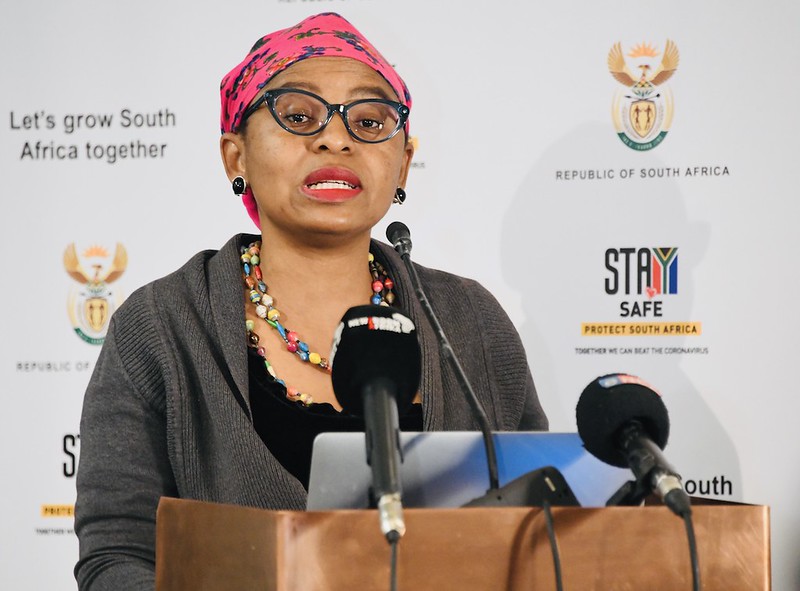
PRETORIA — Minister in the Presidency Khumbudzo Ntshavheni has rejected claims that government waited until public outrage erupted before addressing South Africa’s latest immigration controversy, insisting that officials had been working on the matter for months even though their efforts were not always publicly communicated.

Her remarks follow growing criticism of government’s handling of a Constitutional Court judgment that has triggered confusion over asylum applications, overcrowding at refugee reception centres and protests against undocumented immigration.
TownPress previously examined the political consequences of delayed government intervention in an article titled The ANC’s biggest danger is a government that reacts too late, questioning whether authorities were allowing public frustration to escalate before providing clear explanations and practical solutions.
Speaking at an Inter-Ministerial Committee (IMC) on Migration briefing on Thursday, Ntshavheni disputed the suggestion that government had been inactive.
“The judgment was handed down on the 7th of July 2026, and the uproar started two days ago, which was on the 7th of October 2026, which is literally three months after the judgment, because there was no issue,” she said.
Ntshavheni maintained that government had already undertaken legal and administrative work following the judgment, including approaching the Gauteng Judge President over conflicting High Court decisions concerning undocumented asylum seekers.
“We have not been sitting on our thumbs. We have been doing work,” she told journalists, adding that government did not consider it necessary to announce every step publicly.
However, the government’s own account confirms that implementation problems emerged after the Department of Home Affairs issued instructions to refugee reception offices. The IMC acknowledged that those directives contributed to an unexpected increase in applicants and that Home Affairs lacked sufficient capacity to manage the resulting pressure. The committee has now undertaken to review the instructions, strengthen processing capacity and seek legal advice on the judgment’s implications.
The Constitutional Court ruled in July that asylum seekers could not be denied access to the application process solely because they entered South Africa irregularly, lacked a transit visa or missed a prescribed reporting deadline. The ruling does not automatically grant refugee status, permanent residence or citizenship. Applicants must still demonstrate that they qualify for protection under South African law.
Ntshavheni argued that misinformation surrounding the judgment had contributed to public confusion, particularly claims suggesting that undocumented migrants had been granted unrestricted permission to remain in the country.
She also confirmed that Home Affairs had begun revoking asylum and refugee statuses allegedly obtained fraudulently, following investigations by the Special Investigating Unit. Figures on those revocations have not yet been released.
The government’s explanation provides evidence that administrative and legal work was underway before the latest protests. It does not, however, establish that the measures were sufficient to prevent the confusion that followed. That remains the central issue raised by TownPress’s earlier reporting.
A government can be working behind the scenes while still failing to communicate decisions effectively or prepare public institutions for their consequences.
The IMC’s admission that refugee reception offices were overwhelmed and that departmental directives require review demonstrates that the implementation problems were not limited to misinformation.
The political consequences have already become visible. Protests in Durban disrupted access to refugee reception facilities, while immigration-related unrest in Soweto resulted in vehicles being burned and a foreign-owned spaza shop being stormed.
Although those incidents cannot automatically be attributed to government communication failures, they illustrate the tensions authorities must manage when public uncertainty develops around immigration policy.
The government is now awaiting further legal clarity from the Gauteng High Court, where a full bench is expected to consider conflicting judgments concerning the detention of undocumented asylum seekers on 29 October.
The IMC has also committed to another meeting next week, followed by a public briefing on progress with its five-point migration management plan.
Ntshavheni’s defence establishes that government was not entirely inactive during the three months following the Constitutional Court ruling. The outstanding accountability issue is whether its preparations, communication and operational arrangements were adequate, particularly when officials have acknowledged that the asylum system was overwhelmed.
Anyone with additional information can contact the press desk at press@townpress.co.za or drop a tip on our annonymous platform https://tips.townpress.co.za/