Bosnia votes as 30 years of ethnic politics face new test


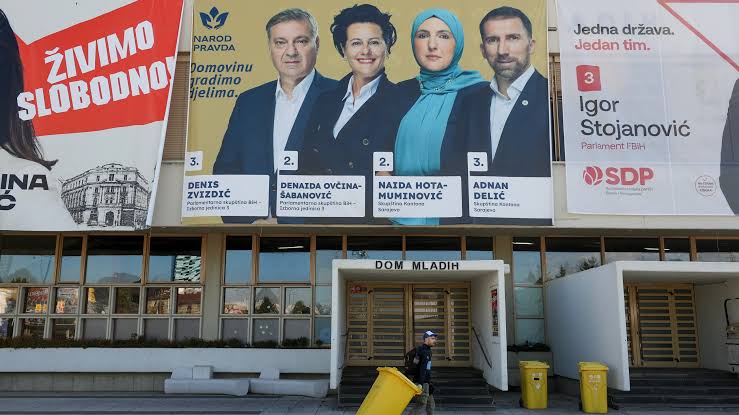
SARAJEVO — More than 3.4 million Bosnians are voting in one of the world’s most complicated elections on Sunday, choosing three presidents and representatives across multiple layers of government as economic frustration, emigration and ethnic divisions again compete for voters’ attention.

The election will determine the three members of Bosnia and Herzegovina’s collective presidency, its national parliament and political leadership across the country’s two main entities, the Federation of Bosnia and Herzegovina and the Serb-dominated Republika Srpska. Voters are ultimately choosing representatives across 14 governments.
The elaborate political structure dates to the 1995 Dayton Peace Agreement, which ended the Bosnian war and created institutions intended to balance power between Muslim Bosniaks, Orthodox Serbs and Catholic Croats.
Three decades later, those divisions continue to dominate politics even as many voters identify the economy, corruption, political paralysis and the departure of younger Bosnians as more immediate concerns.
The election is being closely watched because the next government will inherit Bosnia’s stalled attempt to join the European Union. The country received EU candidate status in 2022 and was cleared to begin accession negotiations in 2024, but progress has been slowed by political blockages and demands for stronger judicial and anti-corruption reforms.
Former Republika Srpska president Milorad Dodik remains influential despite not being a candidate. He was removed from office and barred from holding public office after being convicted over his refusal to comply with decisions of the international envoy responsible for overseeing the Dayton settlement. His SNSD party remains a major political force in Republika Srpska.
Dodik has continued advocating greater autonomy and eventual separation for the Serb entity and has maintained close relations with Moscow. Days before the election, he and Republika Srpska Prime Minister Savo Minic met Russian President Vladimir Putin in Moscow.
On the Bosniak side, incumbent presidency member Denis Becirovic is campaigning for another term against candidates including former presidency member Bakir Izetbegovic. Croat political parties are meanwhile continuing their push for electoral changes that they say would give Croats greater control over who represents them in the country’s three-member presidency.
Sunday’s election is also the first nationwide test of new technology introduced to address concerns about electoral fraud. Biometric devices are being used to verify voters and ballot scanners to record votes, although paper ballots remain part of the process. Several polling stations experienced delays linked to the new systems.
Turnout stood at 28.8% by mid-afternoon, according to Reuters, lower than at the corresponding stage of the 2022 election. Polling stations close at 7pm local time, with preliminary results expected later on Sunday.
The eventual government will have to navigate the same constitutional structure that has repeatedly produced political deadlock while addressing pressure to revive economic growth and advance EU reforms. Bosnia has also experienced substantial population loss, with estimates indicating that about 600,000 people have emigrated over the past decade.
Official results must be confirmed by 20 November, but the first count on Sunday night should begin showing how Bosnia’s voters have divided their support across the country’s competing political and ethnic blocs.
Anyone with additional information can contact the press desk at press@townpress.co.za or drop a tip on our annonymous platform https://tips.townpress.co.za/