
World Bank sees a major risk in Zimbabwe’s currency plan


HARARE, 8 September (TownPress) — Zimbabwe risks triggering capital flight and driving more transactions onto the parallel market if it forces the US dollar out of its economy before confidence in the ZiG has been firmly established, the World Bank has warned as the country moves towards an eventual return to a single domestic currency.

The warning comes in the World Bank’s new Zimbabwe Growth and Jobs Report, released on 4 September, which acknowledges significant improvements in the country’s economy but cautions against allowing recent stability to encourage an accelerated exit from the multicurrency system.
“The government’s goal of transitioning to a mono currency ZiG system carries a risk of premature de dollarisation,” the World Bank said, warning that forcing the transition before establishing credibility could result in capital flight, wider parallel market premiums and the reversal of recent stabilisation gains.
It is a particularly consequential warning for Zimbabwe, where repeated currency failures and periods of severe inflation have left businesses and households heavily reliant on the US dollar as both a means of payment and a store of value.
The International Monetary Fund said in its June assessment that Zimbabwe remained highly dollarised, with about two thirds of transactions by value in the National Payment System conducted in US dollars and foreign currency continuing to account for a large share of bank deposits.
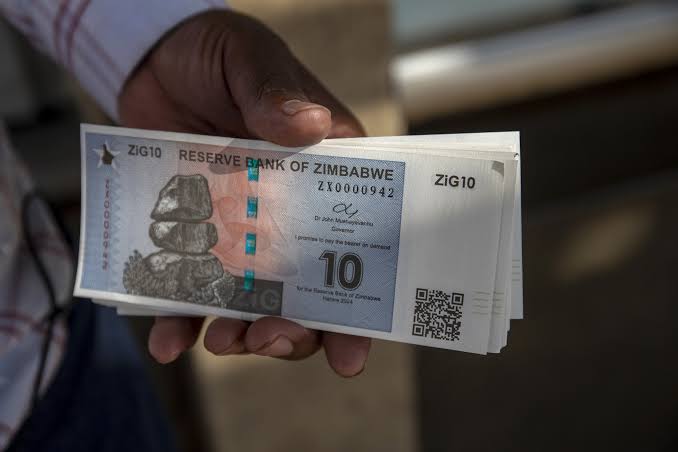
Zimbabwe introduced the gold backed Zimbabwe Gold, or ZiG, in April 2024 as the latest attempt to establish a credible domestic currency. The Reserve Bank says conditions have improved considerably since then, with local currency inflation reaching 4.1% in January 2026 and the ZiG trading within a relatively stable range during 2025. Foreign currency receipts also increased from US$13.3 billion in 2024 to US$16.2 billion last year.
Those improvements have strengthened the government’s ambitions to increase the use of ZiG and ultimately return Zimbabwe to a mono currency system.
However, the current policy is more conditional than a straightforward ban on foreign currencies from 2030.
Reserve Bank foreign exchange guidelines published in March state that the transition to exclusive use of ZiG will be gradual and “not date based”. Instead, authorities say it depends on conditions including sustained single digit inflation, sufficient foreign reserves, exchange rate stability, increased demand for ZiG and confidence in the banking system.
That position is also reflected in Zimbabwe’s programme with the IMF, which says the proposed transition should depend on economic conditions rather than an inflexible deadline. Among those conditions are foreign reserves equivalent to between three and six months of imports and a functioning foreign exchange market without significant segmentation.
The distinction matters because legislation has allowed the multicurrency system to continue until the end of 2030, while government policy has repeatedly identified 2030 as the period by which Zimbabwe wants to have established a sustainable single currency. The latest policy framework leaves room to delay that transition if the necessary conditions are not achieved.
For Zimbabweans, confidence rather than legislation may ultimately determine whether dedollarisation succeeds.
The World Bank’s broader assessment is relatively positive about recent progress. Economic growth averaged almost 6% between 2021 and 2025, while local currency inflation reached single digits in early 2026 for the first time since 1997. But about 80% of Zimbabweans remain employed in the informal economy and nearly half the population lives below the international poverty line.
The challenge for President Emmerson Mnangagwa’s government and the Reserve Bank is therefore not simply getting Zimbabweans to use ZiG. It is maintaining sufficient economic stability for households, businesses and investors to choose the currency without being forced out of dollars prematurely.
The World Bank’s warning effectively puts that credibility test at the centre of Zimbabwe’s dedollarisation strategy: ending widespread US dollar use may be the destination, but attempting to reach it before Zimbabweans trust the alternative could undermine the stability that made the transition possible in the first place.
Anyone with additional information can contact the press desk at press@townpress.co.za.