


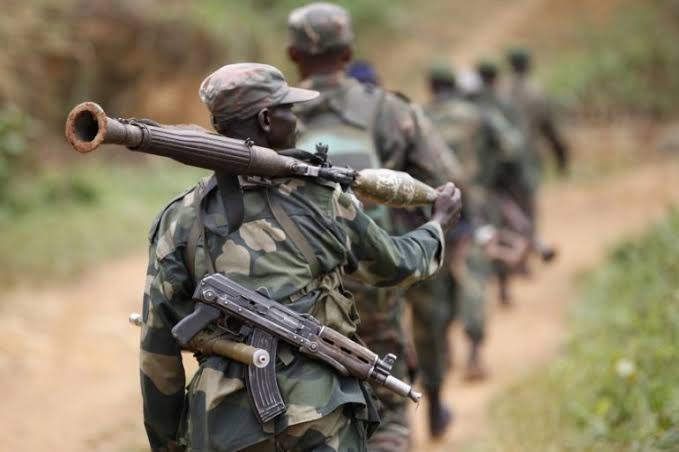
A night vigil at the Blessed Anuarite Catholic parish in Komanda, Ituri province, turned into a massacre on 27 July 2025, when suspected Allied Democratic Forces (ADF) rebels launched a violent assault, killing between 38 and 43 people and injuring at least 15 others. The assailants, armed with firearms and machetes, stormed the church shortly after midnight, attacking worshippers gathered in prayer.
Panic spread rapidly as gunfire erupted and terrified congregants fled for safety. The attackers also burned nearby homes and businesses, with local authorities confirming the discovery of several charred bodies in the aftermath.
This has become the deadliest incident reported in Ituri province this year, surpassing the February killings in Samboko and Matolo villages, where 23 civilians lost their lives.
Among the victims were members of a Catholic youth prayer group, the Eucharistic Crusade. Local clergy confirmed that the majority of those killed were young people participating in the vigil. In response to the tragedy, volunteers began digging a mass grave within the church compound to ensure the victims are buried with dignity.
The scale of the attack has triggered renewed calls for military intervention. Civil society leaders and humanitarian groups are urging both national and international stakeholders to prioritise civilian protection and address the region’s deteriorating security. Many survivors have fled to Bunia and surrounding areas, seeking refuge from ongoing threats.
ADF’s Continued Reign of Terror
The ADF, originally formed in Uganda during the 1990s, relocated to eastern Democratic Republic of Congo in 2002. Since then, the group has been responsible for thousands of deaths, often targeting civilians in churches, schools, and rural communities.
In 2019, under the leadership of Musa Baluku, the ADF aligned itself with the Islamic State, rebranding as the Islamic State Central Africa Province (ISCAP). Though lacking a clear political agenda, the group claims to be fighting for a Central African caliphate. Its attacks are marked by extreme violence and disregard for civilian life.
Despite joint military operations launched by Uganda and DR Congo in 2021, the ADF remains active and dangerous, continuing to stage assaults across the eastern regions. The failure to fully dismantle the group’s structure has left residents vulnerable to ongoing violence.
National and International Condemnation
The Congolese army has condemned the Komanda church massacre as a large-scale atrocity, describing it as yet another sign of the ADF’s persistent threat. Military officials acknowledge that rebel activity in and around Komanda remains a serious challenge.
The United Nations peacekeeping mission MONUSCO denounced the attack as a flagrant violation of international humanitarian law. UN representatives also expressed concern over a recent spike in violence across Ituri, which has placed civilians in increasing danger.
Although government troops have been deployed to affected areas, securing remote communities has proven difficult. Humanitarian organisations are now appealing for urgent global assistance to protect civilians and support those displaced by the violence.
As the search continues for those who went missing during the attack, fear remains high that other churches and gathering places could be targeted next.








Facebook Comments