


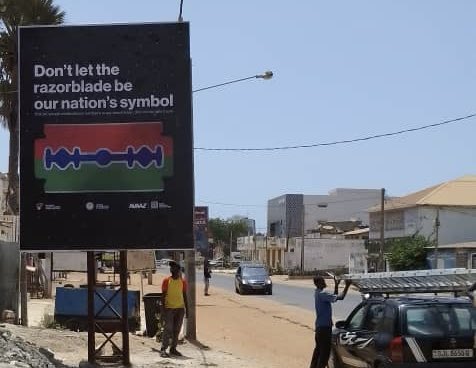
In the Gambia, an uncut lady is referred to as a “solima” in the Mandinka language. Jarjou, who is currently in her 50s, stated that people would tell her that she smells horrible. Nobody wants to be her friend, eat the cuisine she prepares, or marry her.
When Yahya Jammeh, the former dictator of Gambia, banned female genital mutilation (FGM) more than ten years later in 2015, few ventured to oppose him, claiming that the majority religion in the nation, Islam, did not require it. However, Jarjou is now a staunch supporter of a parliamentary campaign to lift the ban.
The Gambia, a tiny nation in West Africa with less than 3 million citizens, would be the first in the world to legalize FGM after it was previously illegal if it were to succeed. The last vote is scheduled for July 24.
“If we stop (FGM), women will suffer … and our children will not know our culture,” Jarjou stated.
FGM is still common in several African countries and diaspora populations despite being outlawed in more than 70 countries globally. It is believed that 144 million women and girls throughout the continent have had this surgery, which often entails the removal of the external genitalia entirely or in part.
The effects can last a lifetime and include trauma, recurrent infections, difficulties urinating, menstruating, and giving birth, as well as chronic pain during sexual activity. According to WHO, FGM solely causes harm and has no positive effects on health.
Campaigners against female genital mutilation (FGM) claim that despite the ban, which the government has not taken seriously, many people in the Gambia still take girls for cuts.
The most recent government health survey from 2019–2020 found that about 75% of women between the ages of 15 and 49 had had the procedure, with 65% having had it done when they were younger than 5. For girls under 15, the percentage reduces to about 46%, according to the survey.
The first FGM convictions came eight years after the ban was introduced, in 2023, when three women were found guilty of cutting eight infant girls. This sparked a public debate about the practice for the first time in Gambia, one that has divided villages and families, and now parliament.

“There is pulling and pressing. Some people think it’s excellent, but others don’t,” Jainaba Ndure, one of Jarjou’s children, remarked.
Ndure said, “I think it’s not good,” to her mother’s dismay, adding that she thought having children would hurt.
At the age of 28, Ndure became aware of the detrimental effects of female genital mutilation (FGM) on women’s health through activism conducted by non-governmental organizations. She mentioned that these kinds of advertising can insult elders like Jarjou.
“They say they are showing us bad pictures,” the woman remarked, pointing to the organ diagrams displayed on women.
CAREER IMPROVEMENT
Two strong men are leading the effort to lift the prohibition on FGM: Almaneh Gibba, an independent congressman from a remote area where the practice is common, and Abdoulie Fatty, a well-known Muslim cleric.
In sermons and television speeches, Fatty openly defended the three ladies who were found guilty and paid their penalties, calling on the government to reevaluate the prohibition. Seven months later, Gibba, a strong opponent of the government, introduced the repeal measure in parliament.
“Enough is enough, Gibba said”We will only be free if we repeal it.”
Supporters of the law in the Gambia have portrayed their campaign, which appeals to many Africans, as a revolt against what they see as Western values being imposed by foreign donors or former colonial powers. Additionally, they contend that the practice has its roots in Islam, which about 96% of Gambians follow, a claim that is refuted by numerous imams and Islamic academics.
The argument has helped Fatty, a former state imam under Jammeh who has no position in the present administration, and Gibba, who was not well-known outside of his constituency, advance in their careers.
According to Gambian law professor Satang Nabaneh, “they can just jump on a very controversial issue, and they will be well-known.”
Suggestions that their campaign was opportunistic were denied by both men. While Gibba claimed to be preserving religion, culture, and custom, Fatty declared he had no interest in politics.
Rights activists worry that the bill would spark a larger campaign to undermine laws protecting women and girls.
“Should they prevail today, the following day’s bill will address child marriage, and the day after that, gender-based violence,” stated UNICEF’s representative in the Gambia, Nafisa Binte Shafique.
Rights activists are also concerned that similar legislation prohibiting FGM in other African nations may be influenced by the Gambia’s measure. A request to lift the ban in Kenya was denied by the country’s high court in 2021.
After Jammeh’s overthrow in 2016, Adama Barrow became president of the Gambia, and he declared that his administration would keep the ban in place while the bill is pending approval by parliament. Information Minister Ismaila Ceesay said that while the government opposes FGM, it will let democracy work its course.
53 MPs voted in favor of the bill, with only five voting against it and one abstaining, on its second reading in March. Four of the five female lawmakers cast yes votes, and one did not. Nobody consented to be interviewed.
However, the health and gender affairs committees of the parliament released a joint report on July 8 suggesting that Gambia keep the ban in place following weeks of public hearings.
The report’s description of FGM as a “form of torture” and “discrimination against women” infuriated Gibba, who claimed the conclusions undermined the faith of traditional leaders and Muslims.
The report was approved by parliamentarians by a vote of 35 to 17 with two abstentions following a contentious discussion.
Political observers speculated that the testimony of doctors and FGM sufferers may have convinced some lawmakers of the negative effects of the procedure, but it was too soon to predict how the bill would ultimately pass.
“We are asking for freedom of choice,” Gibba expressing his continued confidence that the bill will pass.
From the beginning, legislator Gibbi Mballow was against the bill. He claimed that part of the reason for this was because when he was visiting his mother, his four small girls were FGMed without his knowledge. It was only after the youngest had to be rushed to the hospital due to such serious bleeding that he learned of it.
Mballow claimed that in his fifteen years in parliament, he had never witnessed a debate as heated as this one and that he had gotten death threats from unknown people for casting a “no” vote.
Mballow declared, “My political career is in jeopardy.” “Some of my colleagues are terrified.”
pain is okay
One June morning, a group of women of various ages and a few men congregated in a circle beneath a towering mango tree in the town of Sintet, some 86 kilometers (53 miles) east of the city, Banjul.
An anti-FGM activist named Fatou Baldeh mediated a conversation on the technique in her home village while standing in the center and holding the infant of one of the women.
On both sides of the dispute, men and women exchanged arguments and personal tales. A young man expressed his desire to make his wife’s sex experience painless.
Eight-year-old Baldeh, who had female genital mutilation, talked about the associations a young child can form in her mind when someone she loves and trusts takes her to an exciting occasion that ends up being a nightmare.
She said, “You are teaching me as a young girl that pain is OK,” and that girls are also encouraged to remain silent about their trauma, which creates the groundwork for a culture of silence.
According to Baldeh, first, learning about FGM as certain aid groups define it felt offensive. Other women expressed dissatisfaction with the terminology used to characterize their experiences and bodies.
FGM encompasses a range of behaviors. Government figures show that 17% of women in the Gambia underwent infibulation, a technique that involves sealing off the vaginal opening to make it smaller, and 73% of women who underwent it had their clitoris removed along with other tissues.
Hawa Jallow, who spent years cutting young girls in and around the small rural community of Bansang, took great pride in her role as keeper of the ritual.
45-year-old Jallow inherited the talent from her late mother. “If you don’t have a certain type of intelligence, you cannot do it,” she stated.
She was employed by an NGO to oversee the community’s HIV medications after FGM was outlawed, and she stores them in a filthy steel cabinet in her office. But she stated that she was in favor of the practice being legalized once more, claiming that improper or “just for money” use of the technique is the only thing that causes issues.
In their cultures, women like Jallow are held in great esteem. According to anti-FGM activists, they stay in regular contact with the families of the girls they cut, who come to them for guidance on marriage, health, and spiritual matters.
Three such women were detained and punished, judgments that sparked rallies against and in favor of lifting the prohibition, shocking many Gambians.
Protesters claim that those convictions were unusual.
The 34-year-old librarian Fatou Sakho was shocked to discover in October of last year that her ex-husband’s relatives had taken their daughter to be cut without getting her permission.
She has spent months gathering evidence and pressuring authorities to act in order to attempt and bring the guilty parties to justice. But nobody has been charged in spite of her efforts.
Her desperation is exacerbated by the attempt to lift the restriction.
“I can’t find the right words for my anger and frustration towards that bill,” she stated. “I will never understand why grown men find it so important to discuss and fight over … how to cut off female genitalia.”












Facebook Comments